All posts by Caroline

Caroline is a Director at Digital Print Management, a leading print management company specialising in providing print and mailing solutions. Having spent 25 years in the transpromo industry she is one of the UK's leading expert's in print and mail solutions.

How to optimise a hybrid mail solution to mail out information to your employees?

Employees communications

Any employee communication letter can be mailed using print-2-mail

Payroll departments are often besieged with paperwork managing and processing a variety of different employee document streams.

Auto-enrolment forms continue to be a headache for companies along with absence reporting documentation all of which can be manual intensive tasks. But there is a way of mailing out these documents at the fraction of the cost of a 2nd class postage stamp.

How do payroll departments manage to communicate the various bits of information that need to be sent to the employee?

Payslips are a great way of communicating important information to your employees but there are often limitations on space and the amount of detail that can be printed on your payslips.

Emailing information can be time consuming but what if employees don’t read it or the email is misplaced?

Then there is the need to update your employee database with new starters and leavers?

Having a cost effective hybrid mail solution that enables your payroll department to mail out employee communication letters at the touch of a button, without moving from your desk and cheaper than a 2nd class stamp including stationery, envelope, printing and mailing will save the department’s resources in time and money.

How does a hybrid mail solution work?

We are often asked ‘can we just mail out 25 pension statements, a few hundred employee communication letters and what about absence reporting documentation?’ 

The answer is very definitely YES, you can!

Using a hybrid mail solution an organisation is guaranteed to save money on postage, printing and processing.

Hybrid mail is a combination of printing and posting as a bundled service and by combining small mailings for many customers and by optimising DSA (Downstream Access ) pricing is guaranteed to save payroll departments time and money by cutting down on the mundane administrative tasks.

What can I use hybrid mail for?

Any payroll related employee interfacing document as mentioned above.

Variable pages and variable numbers of pages, single sided and double-sided pages, colour documents, any document you need to print and mail out.

There’s no limit to the number of pages so any communication letter that needs to go to employees can be done so with print-2-mail

How secure is it?

The process is very secure and documents are uploaded using an encrypted HTTPS connection (the same standard used for online banking). All your documents are printed in an APACS approved, ISO27001 security production facility.

Stacked MailHow can hybrid mail work for your payroll department?

Aside of the obvious cost savings on processing, printing, fulfilment and postage there are the invisible cost savings of energy, equipment, stationery and consumables.

You can send out from 1 to 1,000’s of letters daily, monthly or when you need to. There are no minimum volumes or minimum usage if you choose to use it for a month and then decide not to continue with the service there is no penalty for doing so!

By using your web browser you can access the print-2-mail web portal by clicking here  fill in your name and email address,  go to ‘branch’ and select “demo” and you will be emailed with your login details.

There’s no software to install and you can use it on a PC or Mac.

By downloading the print driver you don’t even need to create PDF’s. Selecting the print driver launches the application, uploads your documents and converts them to PDF’s.

That’s it, couldn’t be simpler or easier to use.

To read more about how print-2-mail can help your payroll department click here

Follow us on twitter and Facebook, we are also on Pinterest or connect with us on Google+ and Linkedin using the social buttons.



How to outsource your employee P60 printing but you don't know where to start?

p60 and payslip printing

Outsourcing your payslip and P60 printing is an effective way of reducing the headaches in your payroll department.

Why should you use an outsourcing service and are there any tangible benefits?

Outsourcing payslip printing and p60s will save time and reduce the hassle of keeping on top of one of the most complex and daunting tasks for any business, it will also ensure your staff are paid accurately, on time, every time and free them up to concentrate on business related tasks.

To make sure your supplier achieves this you need a reliable partner who can demonstrate they can deliver for you.

With p60s omnipresent I’ve put together some of the most frequently asked questions by customers during the investigation phase to help you along your payslip and p60 printing  journey.

But first here is a quick recap to the benefits of outsourcing:-

  • Experience in delivering the services you need.
  • Expertise in the area or areas in which you operate.
  • Support to help you with any queries you may have during the implementation process and beyond.
  • Technology that can deliver the job now and in the future as efficiently as possible.
  • The flexibility to meet your changing business needs over time.
  • Concise and accurate pricing giving you get the best value for money ensuring you pay for what you need when you need it.

I want to outsource our employee p60 and payslip printing but I don’t know how to start?p60 and payslip printing

It’s not a complicated process if you follow the steps below.

A good provider will discuss and understand your internal processes, how the data files are generated, what system(s) you use and if you already have an existing layout of the p60s, to timescales and deliverables and agree an implementation brief and specification so all parties are working from the same document.

Before you embark on the process of outsourcing your payslips and p60s you need to have a clearly defined set of objectives and a specification that can be presented to the incumbent suppliers during the selection process.

It doesn’t have to be a long winded document on the life and times of the organisation but should include a simple overview of the payroll department as follows:-

  • How many employees work in the company?
  • Are they located centrally or in branch offices?
  • How many p60s are you likely to process and want posted or delivered back to your organisation?
  • What timescales are you looking at? Consider starting with the end in mind for example if your p60s historically get despatched mid April then work back from that date and establish when the data files are prepared ready for printing.
  • Are there likely to be any changes from the HMRC which could slow down the process or require you to make amendments to the current p60 slip?

I only want to outsource our company p60s is that possible?

Yes. Many companies process and print their payslips and ancillary documents in-house but p60s are a time driven task often tieing up payroll departments unnecessarily at a peak time during the year. Simply outsourcing this task can reduce the burden on your payroll department and free up time for staff to concentrate on dealing with everyday payroll queries. Because p60s happen once a year it makes sense to consider removing this task from payroll and as long as you follow the steps above it is a straight-forward process.

payslip and p60 printingI’m worried about the timing, how will I know that my p60s will go out on time?

Firstly make sure you have a clear and planned outline of when they are required to be printed and despatched. It is also a good idea to have what I call a fall back date in other words date 1 is the ideal date you are working toward getting your p60s out the door, date 2 is the very latest date you fall back on should there be any problems with you generating the information you need for the p60s or you have some technical issue which means your despatch window becomes smaller.

The p60 deadline for 2014 is 31st May by which time every company employee should have received a p60.

Agreeing with the supplier the dates and deliverables ensures that all parties are working toward those dates. It is no good agreeing dates and then forwarding a test file two weeks after the agreed date and then expecting a live file to be processed on time.

In my experience companies need to be aware of the impact of missing deadlines. Suppliers can accommodate your wishes but it is a big ask and usually invokes a best endeavour approach.

You have to be realistic and set expectations that your supplier can work to, moving and changing timescales when you are well into the implementation phase makes it very difficult for your objectives to be achieved so bear that in mind.

If you believe you will miss the deadlines due to internal issues then advise your supplier at the earliest so they can re-schedule and work with you.

How do I find the right supplier? payslip printing checklist

There are many companies that can provide outsourcing payroll services. A google search for ‘payslip printing services’ or ‘p60 printing’ will give you a number of options.

The key is to research the services on offer, read what is on their website, look at any relevant articles and evaluate the services, do they meet your key criteria?

When you have a minimum of three potential suppliers contact them via telephone or website and request a call back with more information and details. Using the questions above will tailor the information you get during the conversation. Set up either a site visit to the production facility or request that a consultant visits you to talk through your brief. The next stage will be to get indicative pricing; either you will make a decision solely on price which is unwise or you’ll agree internally on a process of elimination and end up with 2 potential suppliers that you are keen to have further exploratory discussions with.

At this stage you must be absolutely clear what your criteria of selection is for determining which supplier you intend to work with.

We’ve never outsourced before and I’m worried about data security, what compliancy should I be looking for?

I would advise that you work with an ISO27001 accredited production facility where files sent via SFTP, a secure mode of transmission can be accepted. After all, you are outsourcing your employees payroll information. Ensuring that payslips and p60s will be processed accurately, securely and confidentially should be key to your selection process.

What else can I do to ensure the supplier can deliver the service we asked for?

Ask questions, no matter how trivial they might sound they are important and relevant to you. The surest way is to visit the production facility and follow the process through from start to finish if you are happy that the supplier can show you a comprehensive, secure facility and can demonstrate work they do for other companies along with case studies and references then your evaluation is complete.

How do we go about implementing the project?

The right supplier will effectively manage the project from start to finish for you. Reminding you of key dates and deadlines thus justifying their service pricing and reducing the headaches for you. In turn you must be prepared to respond quickly to any queries and make sure the supplier has every bit of information they need to ensure the successful implementation of your project.

We only want a short-term payroll solution?

Although p60s come but once a year companies often need help with fluctuating peak times in payroll where there is a requirement for part-time or casual employees such as christmas time.

Outsourcing your payslip printing for 3- 6 months makes outsourcing an ideal choice for organisations. There is a long held belief that outsourcing involves a long drawn out contractual process and a minimum requirement of three years applicable to I.T outsourcing or payroll function but for print and mail requirements outsourcing can provide a great cost effective short-term solution.

Please subscribe to our mailing list to keep up to date with our news.

You can follow us on twitter, facebook and Pinterest or connect with us on Linkedin and Google+


How to make your message stand out with cross media marketing?

content marketing and cross media

Who is your audience? Where can you find them? What do they want?

So far I’ve sang from the tree tops about the merits of good content, why personalisation is so important and how print fits into the cross media marketing mix.

But what I haven’t shared with you is how do you make sure your content is read?

I should make one thing absolutely clear, this is not a lesson in how to write great content for the internet, this is about how you get your marketing message to stand out from the crowd.

Cross media marketing combines highly personalised targeted messages across the various types of media to seek interaction and engagement with your niche audience.

Cross media marketing is a specific, targeted and measurable marketing strategy designed to deliver consistent, persuasive and actionable messages to your target customers using a variety of social channels over a period of time that engage and reinforce your company and brand.

But it is becoming increasingly difficult to be heard by your prospect let alone engage when the sheer volume of noise from the various social channels is densely populated with mass messages.

Businesses are further hindered by the number of social media channels to use, which one, or combination of platforms are likely to give the best yield of leads or conversions.

Smaller budgets in the current economic climate with which to carry out marketing are limited.

A successful content marketing campaign combining cross media marketing that delivers content and a call to action throughout the channels simultaneously as an integrated campaign.

Brand awareness is 44% print and 37% online media therefore the importance of your brand consistency is essential and it’s not just about making sure the logo is the same across all media.

What do I need to do?

Cross media marketing and print

Cross media marketing what is it and where does it fit in with social media and print?

1. Ensure your brand is coherent across all platforms including print, website, social media. Does it convey your message, your brand and does it represent what the company, service, product stand for?

By developing a consistent brand that delivers meaningful communication your brand effectively demonstrates a strong, authoritative company that knows what they are talking about and in turn this generates trust in your business.

Branding also gives you and your company an identity and personality so that your audience become familiar with you and what you do.

Ensuring you order marketing collateral from the same supplier will guarantee consistency of your brand in the way it looks, the feel and the overall quality.

Cross media marketing focusses on the audience and not the product or service, it is customer-centric and not product-centric therefore delivery of any content or message has to start with a deep understanding of your customer’s objectives and background.

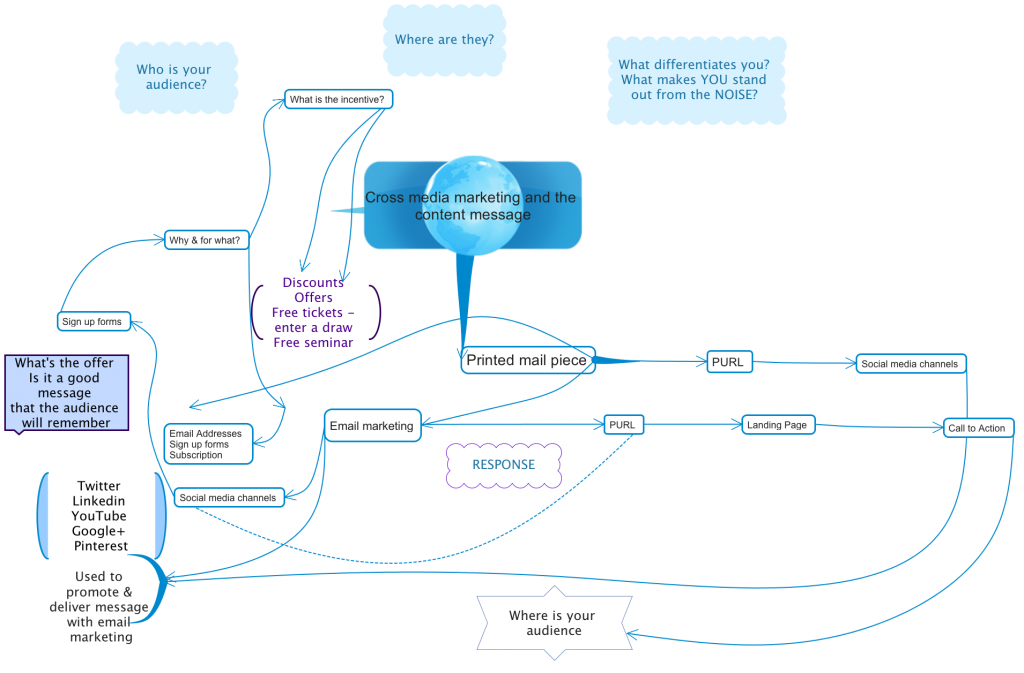
2. Successful marketing messages start with a plan. By developing a well co-ordinated message, ensuring your customer database is accurate and up to date with names and addresses is key to developing the strategy and the content that will unveil itself across all the social media channels.

cross media marketing

A cross media campaign needs to start with a plan. Who is it for, what does the message convey? What is our goal?

3. Use the information you’ve captured about your prospect, you need to understand your audience and be able to identify which platforms they engage on the most. There’s no point sending SMS or using social media if your audience is 75+ and is more likely to be responsive to a direct mail piece. In the same way delivering a message via social media to an audience who are between 18-25 years is likely to be highly effective but it depends on the message and what you are targeting.

It would be like me sending a mass message about auto-enrolment and payroll to debt collection managers, wrong audience, wrong message.

4. Understanding your audience is paramount in developing engagement. Once that’s been done then personalising the content that takes into account all the information will make the prospect more compelled to read.

Each media platform delivers content differently therefore generating a different response. Printed media provides a physical piece of advertising that the customer can read and physically engage with if this is incorporated with an email campaign it creates a better response rate than email marketing on its own.

Knowing your audience can then guide you as to the type of message you want to deliver and what the call to action will be. As I said earlier consistency and continuity are key, use the same colours, logos, images so subliminally the audience start to associate the colours, or the look with your brand. It does work otherwise marketers wouldn’t do it, the constant reinforcing of the message ensures your audience remembers that message and when the time is right it invokes in us the desire to buy from that brand or company.

Personalising the content on the direct mail piece with a PURL moves the customer to a landing page that is completely relevant to him, by asking him for more information thus making future messages more targeted to suit him.

5. Send a follow up email using the information they supplied on the landing page and provide an offer or incentive to jump to the next stage.

6. Send an automated follow up email to those that haven’t responded to either the direct mail or your email making sure there is a PURL to encourage them to go to their personalised landing page.

7. In each of the steps integrate your social share buttons – facebook, Pinterest, twitter and include it on the printed mail piece, showing how and where your company or brand can be found.

8. Finally don’t forget to measure it. Look at your response rates, open rates on email and compile a simple spreadsheet so you can see who viewed what message and on what platform.

9. Start with a two channel campaign such as a printed direct mail piece with a PURL directing them to a landing page and link to facebook then add a third channel and so forth.

10. Remember the key is knowing your audience and making sure you deliver the right content there is no point in sending an email message to a 45 year old mother of 4 directing her to a 2 seater sports car landing page. She may well desire that very car but she’s practical and needs a vehicle that can carry 4 kids therefore the email message is unlikely to light her fire.

11. What makes content and cross media campaigns so useful is the way in which they can interact with each other thus increasing the likelihood of engagement = leads = customers.

Your message should drive your niche audience to do one action only – visit a landing page, register for an event, follow on a social media channel. Give them or ask them to do too much and they lose interest and the lead is lost along with the potential for engagement.

mindmap

A successful message is designed to promote your brand, develop customer relationships, show your company’s authority, subliminally seduce your audience in to remembering you so when they are ready to buy they come to ‘you’.

What do you think?

How important is it that the right message gets delivered to the right social media platform?

How relevant does your message need to be?

How can a print management company help with your cross media marketing and print?

cross media marketingThere are many benefits in working with a print management partner and one of my first blogs exemplified what a print management company can provide and how it can save a company real time and money.

With the recent developments in cross media marketing and content personalisation, working with a print management company will become an increasingly important part in the development of your business marketing strategy.

My last blog talked about the importance of content, used in the properly it can be a very effective way in engaging with the customer.

The most important aspect of any content marketing strategy is ‘interaction’.

Your marketing objective is to establish a conversation with the audience you are keen to interact with and this is where great content is key.

All of the media channels including print should be designed to facilitate the dialogue by slowly building confidence in the expertise and capabilities of your business or you.

Print media innovations are developing quickly, less than 15 years ago it would have been impossible to have a short print run of 50 12pp A5 brochures and to have them personalised and printed with variable information.

Digital print now makes that possible.

Perfume samples can be spot glued to magazines and natural essential oils such as lavender and lemon can be added to print inks to add fragrance to a page. Thermochrome inks can change colour with a change in temperature by rubbing the page to cause a colour change providing the reader with added excitement and intrigue when they read a newspaper or magazine advert or a direct mail piece with the intention of engaging with the reader on a personal level creating empathy resulting in  the buying of the product.

Invisible information, hidden messages or information seen only under certain light or after a set period of time created by using UV light sensitive inks traditionally used in the cheque printing industry to prevent counterfeit have found their way into marketing campaigns providing the customer with a different print experience.

How does print help me with my digital marketing strategy? cross media marketing

Print media can now include markers that link printed medium with digital media. The QR code (Quick Response) is a small square code that when scanned with a smartphone opens a file or links to a URL or a PURL enabling the viewer to engage with the brand or company.

AR (Augmented Reality) is hidden content, hidden behind marker images that can be included in printed and film media but when viewed using a mobile app open a world in which the brand is at the heart of the message or create scenes in which the brand and the consumer play a role.

VIP (video-in-print) brings the audio video channel to printed media. This is a small screen 90mm wide and just 3mm thick that can be inserted into a brochure or magazine and present HD video and audio. This technology adds content that could previously only be seen on television or heard on the radio.

How can a print management company add value to my marketing strategy?

Print media, television, online, mobile technology and social media are all vital components of a potential marketing campaign, whilst only the large brands and corporations are likely to use all components to market their content, the majority of businesses will use some of the platforms in conjunction with each other to promote content. With such a range of channels available how do you ensure that you are getting the right expertise, exposure and ROI for your marketing spend.

cross media marketingAnswer:

Step in the print management company

A print management company can provide a vast array of services and products through its distribution channels and trade supplier network, relationships that have been built up over many years. Print management companies year on year are able to save their customers 25%-30% on print spend. The job title ‘buyer’ doesn’t automatically make you an expert in print buying and knowing where to source what from who.

Print management companies are, by their very nature diverse, they’ve had to make changes to meet the needs of an ever changing marketplace and to accommodate the variety of needs of clients by being able to provide multi-channel services from data management, direct mail response and management, augmented reality, PURL’s, web to print, interactive QR codes, email and SMS marketing.

A far cry from ‘PRINT’.

Many companies find that by managing their cross media marketing efforts involves cross fertilisation of services from print to social media and companies don’t have the knowledge to deliver a cross media marketing project. Either companies will need to invest in staff that can manage the various components internally or outsource to get the best results.

What starts out as marketing or branding campaign designed for printed media, the next stage maybe email marketing and its distribution through various media channels. One person in an organisation wouldn’t be able to co-ordinate the process from print to social media let alone several people. Many don’t perceive print or social media as a core component of their business strategy because it involves so many stages, requiring you to be an expert in every channel.

Outsourcing to one company ensures that the right media channel is used for each of the respective marketing components in other words, print media with interactive QR codes might be the first step in the engagement process followed by email marketing with a PURL, SMS mobile marketing,  and so on.

A print management company doesn’t have a vested interest in anyone particular media channel or supplier, they will work with the customer/company to ensure that the brand, content, service or product is effectively positioned to get the best results.

One supplier, one contact for all your cross media and social marketing needs.

For more information on how cross media marketing can help your company click here

Why content marketing sucks?

how does content marketing fit in with print20+ years in print has provided me with a good education into what makes good and bad content. Of course this is subjective what might be great content to one is mediocre to another.

I’ve seen how customers got it very wrong and hit the spot by getting it very right.

A direct mail piece containing variable content with no relevance to the product or service, an invoice with the wrong marketing message, often a missed opportunity for suggesting to clients future products or discounts, blank spaces over a page, content that bears no relevance to what the company sells.

Giving your customer the chance to bounce from paper and join you in the digital world by offering them an incentive can be one of the most effective ways of using your content.

Content marketing is the 21st century most used catch-phrase, content is king, content is everything, content is to die for.

Good content, but not any content is a must these days for companies, organisations or brands that sell products, services and solutions.

Let’s start with a definition.

Content marketing is any marketing format that involves the creation and sharing of media and publishing content in order to acquire customers. This information can be presented in a variety of formats, including news, video, white papers, e-books, infographics, case studies, how-to guides, question and answer articles, photos. Content marketing is focused not on selling, but on simply communicating with customers and prospects. The idea is to inspire business and loyalty from buyers by delivering “consistent, ongoing valuable information”. [Wikipedia] What is content marketing

Many believe content marketing is crucial to developing and nurturing new and existing relationships, unsurprisingly, few do it properly.

What do I mean by this?

When companies decide to go down the route of content marketing it is often with little or no plan. It might start with a post card style marketing proposition in an attempt to reach customers and prospects. This is then followed up with a special offer or discount on your next purchase on a social media platform like facebook or twitter.

No planning, no continuity.

Many companies don’t think about the message they are trying to convey or what they aim to get out of the campaign.

Price, quality or a service message isn’t enough to differentiate you from your competitors and so the customer gets distracted by the price and forgets what he/she really wants in terms of a solution, product or service.

In turn this results in content that offers little or no real value to the end user, leads don’t convert into customers and sales are lost even though the brand may have captured the buyer at the first touch point.

Content marketing is about engaging and educating your customers in a subliminal way.

Content marketing is about engaging and educating your customers in a subliminal way.

Content marketing works on the proviso that there is a group of people out there wanting more information on your products and services, the content you showcase might be a solution to a problem they didn’t know they had.

It is providing information about the services and products that your business offers to help prospects that are wanting to purchase but are uncertain about making that final commitment. It is not blatant SELLING.

Content is about providing relevant information over time by creating a positive image of the company, brand or you, equipping customers to make the right decision and buy from you, it is not about lam-blasting public messages into the social media stratosphere hoping that some of the messages will stick. (Outbound marketing)

content marketing and print

Why is content important and where does print fit in to the mix?

Why does content marketing suck?

It doesn’t really I just wanted you to read my post.

Joking aside, print has conveyed this message since the beginning of time. The print industry has always been at the forefront of content. We know about the value of content in a direct mail piece, a brochure or sales letter, because we’ve been talking about it with our customers for the past 30+ years.

It doesn’t matter what the print piece is it could be an invoice as I mentioned earlier or a sales letter, it’s what’s in the content that counts.

The same principle can be attributed to digital media content. Content on the web, blogs, sales articles, email newsletters.

What has changed is the media marketing mix. Up until 5 years ago print tended to be the main vehicle for conveying content and information. Print is now just one part of the social media and marketing mix or as I like to call it part of the multi-channel engagement with customers.

The whole point is to develop interaction and engagement with customers by using all of the channels including print.

Content marketing seeks to answer questions, provide solutions and the social media channels are the mode of transport that allows this conversation to take place.

Where does print fit into the social media mix?

Let’s take a company newsletter, a magazine or a direct mail piece, the chances are it will be kicked around a building way after you’ve deleted that last ‘salesy’ email.

A great example of how paper fits into the marketing mix is the way Google interacts with its prospects and customers using direct mail.

Recently, we received a highly personalised target specific direct mail mini-brochure, about the size of an A6 post card and with 8pp (printed pages). It detailed the number of site visits, adword campaigns we are running and SEO all in a digital colour printed booklet. Targeted, strategic and personalised.

Google using direct mail? – a paper based product to deliver a marketing message. Google a multi-billion pound digital company specialising in internet related services using PRINT AND A DIRECT MAIL PIECE to promote themselves, ironic don’t you think. But, If it didn’t work they’d stop using it.

Understanding the value of print when considering your content delivery and more importantly the creative uses of print, can only enhance the customer experience.

Don’t rule out print as a potential first step in the engagement process with your customers.

content marketing helps you connect

Content helps you connect with your potential customer

Ask yourselves how you felt when you last opened a highly personalised envelope containing an individual sales message addressed to you? What did you think when you read it? If you thought wow I really like that, it’s fresh and different.

Now put yourselves into your prospects shoes, now you get the picture.

How are using print for your content marketing?

How do you see it fitting in with your marketing strategy? Please do share your thoughts, I’d love to know what you think.


Information and document management on the move

information security

Document security on the move

My last blog discussed the importance of having a document management company policy that ensures integrity and security of company information.

But what happens when you are on the move or working from home? What information or document management protocols do you have in place?

Recently, I was on a train to London and took the opportunity to write up a report and read through a proposal, nothing unusual in that.

But as the journey continued I was irked by a commuter who was sitting next to me and kept peering into my laptop screen.

I didn’t have a laptop privacy screen so I was well aware that he could catch some of what I was reading and writing.

You might be thinking what a stupid thing to do but there was no confidential information on display and nothing onerous that anyone reading it could use to affect.

That’s not the point I was irked because he persisted in deliberately reading in my space and this got me thinking.

Do organisations need an information management policy and is it really necessary?

How many of us actually travel with company work documents – paper and digital, and read them in view of other commuters?

The british workforce has become increasingly mobile, we travel further and more often.

Many employees use planes and trains.

If you take a train during peak commuting periods it is not unusual for people to use this travel time to work on their smartphones, laptops or tablets, reading important documents and responding to emails in full view of all and sundry.

Not forgetting that endless business phone call the woman sitting next to you is having and divulging all sorts of interesting information if you care to listen.

I picked up a potential company lead because a woman on her phone name dropped,  she was talking so loudly it was hard not to hear and everyone understood the context of the conversation not very secure or confidential and I wondered what her client (I assumed it was a customer) would have made of the conversation had they known she was travelling on a train.

Would they have questioned her about the existence of a company information management policy?

How many times in the last few years have we heard about breaches at the home office or NHS trusts inadvertently sending out information to the wrong patients.

It happens innocently due in part to carelessness like divulging confidential company information on a mobile phone, reading sensitive documents whilst on a train, bus or plane.

You may not think your friendly commuter sitting next to you isn’t in the least bit interested in what you are reading or writing but look at the statistics below and it might make you think again.

http://www.slideshare.net/CarolineMcCormack/commuter-snoopers-jan14

Employees should be aware of an information management policy particularly when working remotely or in transit providing clear and practical guidelines to ensure employees reduce the risk of losing information or worse still falling into the wrong hands.

Paper is very easy to transport to and from the office and just as easy to misplace or leave on the train on the way home. When these documents are no longer required employees should be required to return them to the office and have them destroyed on company premises.

Organisations need to manage information appropriately ensuring that devices issued to employees such as mobile devices, laptops or tablets are encrypted with passwords and any sensitive information is managed via a secure VPN connection (virtual private network).

Laptop privacy screens ensure that if work is being undertaken on a journey, it makes it impossible for the information to be read from a side view.

Of course this reads like common sense, BUT

Next time you are travelling count the number of potential information and security risks, you will be very surprised just what you see and what you can learn!

When you next make that phone call to an important client or read sensitive documents. Be aware of the security risks.

When you next make that phone call to an important client or read sensitive documents. Be aware of the security risks.

For more information on document management systems and solutions click here

Does it really matter how you transport information?

What management policies do you have in place?

How do you manage your information and any paper documents when you are on the move?

Follow us on twitter, find us on Facebook and Pinterest or connect with us on Linkedin and Google+


Document management. How to bridge the gap between paper and digital.

Document management

Document management security why do you need it and how can a document management solution help?

We all carry lots of vital often-sensitive information – whether it’s carried on a smartphone, tablet, laptop, USB stick or as paper files. 

Important data such as company information, a detailed proposal for a prospective customer, financial information relating to a specific client left on public display could prove to be a serious issue for you and your client.

Leaving things on a train, restaurant even at a client’s desk after a meeting is an unpleasant reminder of how a lapse in concentration can cause distress, embarrassment, upset and in some cases be very dangerous.

Thankfully those of us who leave gloves, keys or a wallet whilst these items are replaceable the loss can be downright inconvenient.

Printed matter is a different issue. Paper documents can’t be encrypted and transporting paper has its associated risks. Taking sensitive documents from one location to another a seemingly harmless act yet often necessary can quickly become a security issue.

In reality they are simple everyday mistakes that human beings make.

Protecting printed documents is not easy and a breach in compliance can be costly.

Back in the 80s, the paperless office was predicted and although we are still along way from achieving that, compliance and environmental sustainability will be a factor in reducing the number of non-electronic documents produced and distributed in the future.

Can we have the paperless office?

How do we manage and secure paper based documents?

Digital documents are secure but how do we address the security of paper-based documents?

It is unrealistic to handcuff ourselves to the briefcase we are carrying the documents in nor can we walk around with a vault attached to our backs. Making employees aware and ensuring there is a document management system in place minimises the risk of paper documents going array.

How does document management prevent disasters from occurring?

Document Management helps to reduce the volume of printed documents in a number of ways.

Users can scan or batch scan printed hardcopy documents and have them automatically transformed into a format that can be stored in a document management database.

Document management software creates a secure digital file cabinet for an organisation, in effect it is a digital archive where you can securely store any document type and then find it weeks, months, years later.

Document management solutions add value by saving time and money because documents stored can be indexed and retrieved by users in a secure manner meeting compliance criteria and reducing paper document storage costs.

No longer the premise of large organisations, companies can benefit from document management solutions where compliance requires retention and or destruction of documents within specified timescales. Providing scanning, imaging, document archiving, fax archiving, and electronic records management all accessible within a digital cabinet.

Document management is an integral facet of the disaster recovery plan of an organisation, document automation helps the process of quickly and efficiently managing paperwork and other documents in an electronic form.

The question that needs to be asked by an organisation is “what am I looking to achieve and what is the best solution to achieve that”?

From print to automation

Why automate?

Many people use paper as a bridge between systems that aren’t working effectively such as the link between the supplier and customer in the form of contract, invoice, statement or a link from one internal process to another.

Most documents start their life in a paper format and contain data that has been extracted out of an internal system i.e. AP/AR and then is eventually stored in a digital repository.

Document management solutions

DO we really need to print and store paper?

In an ideal world why print?

By improving internal systems and business processes and receiving documents electronically there is a case to argue that paper could be eliminated. Keying errors are reduced, data is less likely to be lost, decision making is based on accessibility to current and up to date information and distribution costs i.e postage are reduced.

Paper also presents other challenges notably mobility.

With so many people working remotely how do staff further the next stage of a paper based business process if they are not located in the same office? 

As soon as confidential information has been printed it is vulnerable to being left or misplaced somewhere therefore data integrity and security is compromised. Workflow speed is reduced as paper based processes are slower and less efficient.

What about storage?

Cloud based storage is cheaper than having warehouses full of archived boxes and more complex to index and therefore find let alone remember where the information has been stored.

document management

Storage in a digital repository means information is accessible for years to come

Then there is the issue of retrieval. Document management solutions provide flexibility and scalability.

Paper and print has other associated costs – print consumables, maintenance, paper, postage, envelopes, files and filing cabinets, floor space, logistics’ and distribution.

Consider what you print. Why do you print it? Where will you file it once printed? What elements of your business would be most affected if you stopped printing now? Could the medium be replaced with a better digital alternative?

What would happen if you lost that document?

One final thought.

How much of your corporate stationery is tied up in office space, human capital and your customer communications associated with paper?

For more information click here

The best of 2013. How to outsource all in one place

The penultimate day of 2013 sitting at my office desk reflecting on the year that has been. iStock_000025583727Small

How quickly we seem to slip from one year to the next.

A time to be melancholic or a time to be reflective?

Looking back on this time last year and my final blog for 2012, I can recall putting it together and what I was thinking at the time.

Shame that the short-term memory isn’t quite as good as the long term one!

Philosophical yes.

The economy is shifting marginally and there is some optimism but we still have some way to go.

iStock_000014895105XSmallIrrespective of how good or bad the year has been it’s always a good thing to look forward with optimism.

It’s a time to plan. I don’t do new year’s resolutions I think they are waste of time I prefer setting some goals broken down into personal – family and health goals, business and company goals, family and friends and finally house goals – what I want to get sorted in the house for 2013.

That way I can attribute dates with a realistic time line and do my best to achieve them.

For my final blog, the best of 2013 I wanted to continue the theme I started at the end of 2012 with a summary of the various articles written throughout 2013.

This year’s articles have been focussed on helping companies get the best from outsourcing whether it is print and mailing services , hybrid mail solutions, cheque printing and payroll processing and printing.

In May, I introduced you to 3D printing, used extensively in motor manufacturing and F1 Motor Racing R & D, it has some way to go before it becomes mainstream.

It will become increasingly useful to organisations over the next 3-5 years. The difficulty for organisations will be understanding how and what applications 3D printing can be used for.

The benefits will be unprecedented. Being able to print 1 of anything or a prototype of a new product, think direct mail applications, mailings to your customers demonstrating a new product.

Remember when digital print first hit the mainstream? Then apply the same thought process to 3D printing!

Cross media marketing and print

Cross media marketing what is it and where does it fit in with social media and print?

The growing phenomenon of cross media marketing personalisation is having a positive impact on print. It has been mainstream for some 2-3 years but companies are uncertain how to implement it alongside a marketing plan.

Paper is becoming the first touch point of engagement with the customer before taking them on to a digital or social platform.

Marketing personalisation and social media will become increasingly important to a companies’ marketing and strategic planning process when it comes to personalised engagement with it’s targeted audience.

If you click on the link you can read why it will be important to you:

What is marketing personalisation & what does it have to do with social media?

Mailing out a direct mail piece to your customers with no thought or personalisation will be ineffective in seeking customer engagement.

The cross media marketing mix has to be strategic, personalised on a level the audience can relate to and be part of your social media activity. If you hit the button below I discuss it in more detail:

Please click here to read more

I’ve extolled the virtues of multi-channel distribution – using both paper and electronic means of delivering an item to your customer.

The paperless office?

I think we still have some way to go to get there and I cannot be an advocate of a paperless office, paper has an intrinsic value in our everyday lives and you can read my opinion here:

Why print has longevity

It is foolhardy to perpetuate the myth that electronic delivery methods save organisations time and money – it does not.

The important thing is to develop and understand the reasons for moving to electronic means of delivering messages to your customers.

A well thought out plan and strategy will see that paper and electronic are essential to maintaining good relations with your customers.

You can read why here:

Print, digital and the cross media marketing mix

Social media communication concept

If there is one thing I try to convey to customers and readers alike is to make sure you research and evaluate suppliers.

Your relationship should be a marriage and not a relationship based on convenience.

Adopting a “get the cheapest supplier” attitude is doomed to failure so why bother with the headache.

This article sums it up:

Top tips for choosing the right print supplier

So that’s it. I hope you’ve enjoyed reading the best of the rest.

Thank you for visiting Digital Print Management’s blog and for reading and sharing the content through Linkedin, twitter, facebook and Google+, for taking the time to add your comments.

I hope that 2014 will be a successful year and may you continue to prosper financially and spiritually.

My final note for the year:

“A pessimist sees the difficulty in every opportunity, an optimist sees the opportunity in every difficulty” Winston Churchill

A good mantra to adopt for 2014, don’t you think?

Happy New Year.

Happy New Year.


 Follow us on twitter, facebook and Pinterest or connect with us on Linkedin and Google+


How to find the right print and fulfilment services supplier?

print and fulfilment services

Working with a proven print and fulfilment partner ensures your brand’s continuity

In spite of Royal Mail price increases and the availability of multi-channel distribution for documents, organisations still have a requirement to mail out letters, invoices, statements and remittances.

Every organisation faces the challenge of producing great content, delivering it in different formats from paper to digital and being able to produce more with less and with a reduced marketing budget.

The problem is how do you find a print and fulfilment service that that will offer expert advice and deliver the end product to your customers?

Achieving this can be a difficult task to accomplish.print and fulfilment services

Can organisations trust a potential print and fulfilment services supplier?

Is there a reason why you shouldn’t partner with a print and fulfilment supplier?

A supplier you have a good relationship with, who, will give you honest feedback which in turn helps deliver on your customer relationship strategy and grow as a business.

Suppliers are an integral part in developing and protecting your brand awareness and there are tangible benefits to working with a single vendor who understands your vision, direction and the various challenges you face as an organisation.

Selecting a reputable print and fulfilment supplier is a lot like a marriage, you need a partner that listens, understands your goals, how they will be delivered and ultimately be loyal to your company and brand.

Fundamentally it must be a partnership based on trust and communication.

Key points to think about before working with a print and fulfilment services supplier

1. What is the vision for your organisation? Where do you want it to be in say 3-5 years? What things do you want to change? How would a print and fulfilment supplier benefit the company?

2. How do you market yourself as a company? What is your brand and has it come to fruition? Are you well known? Do you have a good reputation with your customers?  How are you positioned in relation to your competitors?

3. What challenges do you face within your industry? What new technologies and solutions would benefit the organisation but due to cost constraints cannot be fulfilled in-house?

print and fulfilment servicesHow to choose the right print and fulfilment company

1. How often do they review the services with their customers?

At the very least you should be visited by your supplier every 6 months.

This will ensure you are kept up to date with latest innovations, products and services and it also gives you the opportunity to highlight any issues that you may not be happy with. It is also important to advise your supplier of any up and coming print campaigns and direct marketing efforts that are being developed.

This ensures that both you and your supplier collaborate on new projects so that you get the very best solution for your next marketing effort.

2. How proactive is the potential supplier in suggesting alternate print and fulfilment solutions to ensure you get the best service for all your printing needs?

An expert advisor will seek to understand what your intentions are as an organisation and what you hope to deliver with each marketing objective that way the supplier can stay ahead and suggest practical solutions that deliver the best results.

3. What accreditations do they have?

ISO 9001, (quality) ISO 27001 (Information Security & Management)

Having the above accreditations ensures that best practice is maintained and that procedures and processes are in place it also ensures that any confidential data is correctly managed and that the company can demonstrate the relevant protocols.

4. Is the print and fulfilment provider customer centric? Will they provide bespoke solutions for you rather than fit within the constraints of their services and equipment?

The key to any long term relationship is whether the incumbent supplier can deliver your needs now and in the future.

5. Will they be flexible and respond quickly and systematically to a change in specification or delivery dates?

What system(s) do they have in place to make sure they can manage any last minute changes?

6. Can the supplier offer free data cleansing and checking to ensure your addresses are complete and suitable for mailing discounts?

7. Is the print and fulfilment company financially stable?

How long have they been in business and what customers do they currently supply?

8. Can the print and fulfilment company produce what you want to sell today and tomorrow?

Think about the future products and services you are working on as an organisation. Can the supplier accommodate your needs now and in the future. There’s no point in establishing a rewarding relationship only to find out in year 2 that one of the marketing campaigns you intend to develop cannot be fulfilled by your supplier.

9. Does the print and fulfilment company have a great reputation?

Ask for testimonials or a list of references and it’s also a good idea to ask the supplier to give you an example of a case study

10. Is the print and fulfilment company’s pricing fair?

When reviewing print and fulfilment companies, it shouldn’t come as a surprise to see the difference in prices from one supplier to the next. By ensuring the supplier has matched your specification only then can you make a comparison between other suppliers. A higher cost may indicate that the print and fulfilment company are offering a higher level of services. Again is this what you asked for or is the supplier being proactive by demonstrating what should be incorporated into the campaign.

10. Hypothetically, if a job goes wrong, after all, we are only human, is the supplier able to demonstrate best practice? Do they have the capability to ensure that the right processes are in place to resolve the issue

A slightly difficult one to address in the ‘what if stages’ but an organisation should be able to ask the question  of the supplier and establish how flexible they can be in the event of a mistake being made.

Any print and fulfilment company you consider should be happy to answer your questions and be able to demonstrate fulfilment and print capabilities so that when you decide on your chosen supplier you can be confident in the knowledge that the marketing campaign can be delivered from paper to digital to social media.

print and fulfilment

Need some help with a print and marketing campaign?

Want to be able to send out customer letters but don’t know where to start then Call us for more information by clicking here

Are there any other points that should be added to this list?

What do you think?

Follow us on twitter, find us on facebook and Pinterest or connect with us on Linkedin and Google+. We look forward to getting to know you.


Print, digital media and the environment. Dispelling the myths of print and paper.

Can we have the paperless office?

What’s wrong with print and paper?

I was challenged recently by a customer who suggested that sending information electronically rather than using printed media is more socially responsible and better for the environment.

When I quizzed him on his understanding of how paper is produced, it’s overall contribution to our lives in general and that trying to eliminate paper entirely from an organisation whilst might be considered eco-friendly to the outside world is actually misleading and detrimental to the paper manufacturing and print industry.

There are many myths and misconceptions that print, paper, direct mail, newspapers and just about any other paper based product is having a knock on affect on the environment.

Ask yourself this question –

When was the last time you read a sales email from start to finish before you then hit the delete button?

How many unsolicited emails do you get VS direct mail pieces?

How do you react to receiving a highly personalised direct mail piece, so well targeted you’d almost think it’s been produced especially for you as opposed to an unpersonalised unsolicited email?

Paper and electronic/digital can co-exist in our world and can synchronise very well indeed, thank you! The paper less office has been talked about since I entered the print industry, over twenty years now.

Customers think they want a fully integrated electronic solution that communicates with the customer by eliminating the need for sending anything that is paper.

Why?

Because there is the long held belief that electronic communication is more environmentally friendly than print and paper and will save an organisation time and money.

Go paperless, don’t print this email, go green are common strap lines we’ve become accustomed to with organisations, corporations and utility companies perpetuating the myth that by communicating electronically they are saving money and helping the environment.

But organisations who relentlessly support a paperless project or goal do so without understanding all the facts and in my experience without really understanding why they are doing it.

There is no consultation with their customer, no preferences are provided, in other words they ‘tell’ the customer they are phasing out or removing paper bills and migrating to electronic methods of communication without asking the permission of their customer or at least asking them to opt in to the idea, which is better for them – paper or electronic.

  1. Electronic waste is now the fastest growing component of the municipal waste stream
  2. The amount of electronic products discarded globally is 20-50 million tonnes every year
  3. Across Europe, e-waste is increasing at 3-5% per annum, three times faster than the waste stream (Source: Greenpeace – The e-waste problem, 2013)

Print and paper is wood based, a natural and renewable resource with over 70% of print and paper being recycled in europe for reuse.

print, paper and electronci

Paper is a natural and renewable resource. Over 70% of print and paper is recycled in Europe for reuse. It is NOT a wasteful product.

Newspapers, magazines, leaflets, even car show rooms insist they no longer have a hard copy brochure available and are using cost and the environment as the perfect excuse. These messages brand paper as an unsustainable commodity and unnecessary in the every day scheme of things.

Fact – Paper is made from renewable resources, recyclable and produced by and environmentally conscious industry whose future is dependent on planting more trees than it consumes.

Fact – Forestry, paper and packaging are among the most sustainable industries in existence

Fact – Paper is based on wood, as young trees grow they absorb CO2 from the atmosphere. Paper as a wood product continues to store carbon through its lifetime. A well managed forest, used and re-planted, absorbs more carbon dioxide than a mature forest consisting of older trees.

Fact – The paper industry has certification schemes ensuring the paper you use has come from a sustainable forest source. There are 30 schemes in place, the two most prominent and audit-able certifications are the FSC (Forest Stewardship Council) which provides a global standard for forest management including environmental, social and economic well being of the forest communities and ecosystems. The PEFC (Programme for the endorsement of forest certification) is a certified tracking mechanism designed to ensure that from forest to final product the wood and wood fibre can be traced back to certified forests.

Fact – Paper production is not a cause of deforestation world wide

Fact – European forests are 30% larger than in 1950

Fact – The annual increase of forest cover in Europe is equivalent to 1.5 million football pitches

Fact – The european recycling rates for paper reached 72% in 2012, the highest ever recorded

Fact – Between 1990 – 2010, 870 million tonnes of CO2 have been removed by european forests equivalent to 10% of the greenhouse gas emissions (source: MCPFE, state of europe’s forests 2011)

Fact – 90% of deforestation is caused by unsustainable agricultural practices

(Source:www.twosides.info)

There you have it a quick synopsis of why paper should not be discounted when considering a move to electronic methods of communication with your customer.

Moreover it is fool hardy to brush aside paper as if it’s no longer an essential commodity?

Picture the paperless toilet!

paperless toilet

Mum where’s the loo paper gone?

Paper and electronic means of communicating can co-habit but rather than asking which is better, paper or electronic, users need to be re-educated into thinking what mode of communication best serves the customers interests and how can the two work together to deliver the right result?

As for my customer, he scratched his head and said “perhaps we need to think through our so called paper reduction strategy some more?”.

What do you think? Has paper had it’s day?

Are you still using paper in your offices?

Do you operate a paperless office but realistically still have paper on your desk?

Please do share your thoughts with us.

If you have achieved your ideal of going paperless or paper is still a very important part of your business let us know and we will write you up as a case study.

If you want more information about dispelling the myths of paper and print head over to www.twosides.info


Please follow us on twitter, facebook and Pinterest or connect with us on Linkedin and Google+